Automotive websites
Why a Tune Shop Needs a Better Website (and What It Should Show)

Raymond Hernbrode4 min read
People spend weeks researching a tune before they ever call. Here is what they look for on a tune shop website, and what I would put on the page.
If you tune cars for a living, you already know your customers don’t just wake up and book a tune.
They’ve watched videos. They’ve read the forum threads. They’ve asked around about which shop to trust with a car they’ve put real money into. By the time they message you, they’ve probably looked at a few other shops too.
So here’s the uncomfortable part. Your website, or the lack of one, is part of that comparison.
What a careful customer is trying to figure out
Picture someone with a car they care about, deciding who gets to touch the ECU. In a few minutes on your site, they want answers to a handful of questions:
- Do you work on my platform? Not “European cars,” but my exact car and engine.
- What are your packages, and what does each one include?
- Can I see results from cars like mine?
- Where are you, and how do I get my car to you?
- How do I reach you, and what will you ask me?
If they can’t find those answers, they usually don’t call to ask. They go to the next shop on the list. That’s the real cost of a site that’s out of date, hard to read on a phone, or missing altogether.
Facebook and Instagram are good, but they’re not enough
I’m not telling you to quit posting. Build photos and dyno clips are great, and that’s where a lot of customers will first see you.
But a social feed is bad at the things above. Packages get buried under months of posts. A dyno sheet from last spring is nearly impossible to find. And you don’t control how it looks or what shows up next to it.
A website is the place those answers sit still. You can send the link to anyone, and it shows what you want them to see, in the order you want them to see it.
What I’d put on a tune shop website
For a tune or performance shop, I’d start with a single page and keep it focused. Here’s the order I’d use:
- Who you are and one way to reach you. Shop name, city, and a clear button to ask about a tune.
- Platforms you support. The makes, models and engines you work on. This one list saves you calls from owners you can’t help, and tells the right ones they’re in the right place.
- Packages. Stage packages, custom tunes, and what’s included in each.
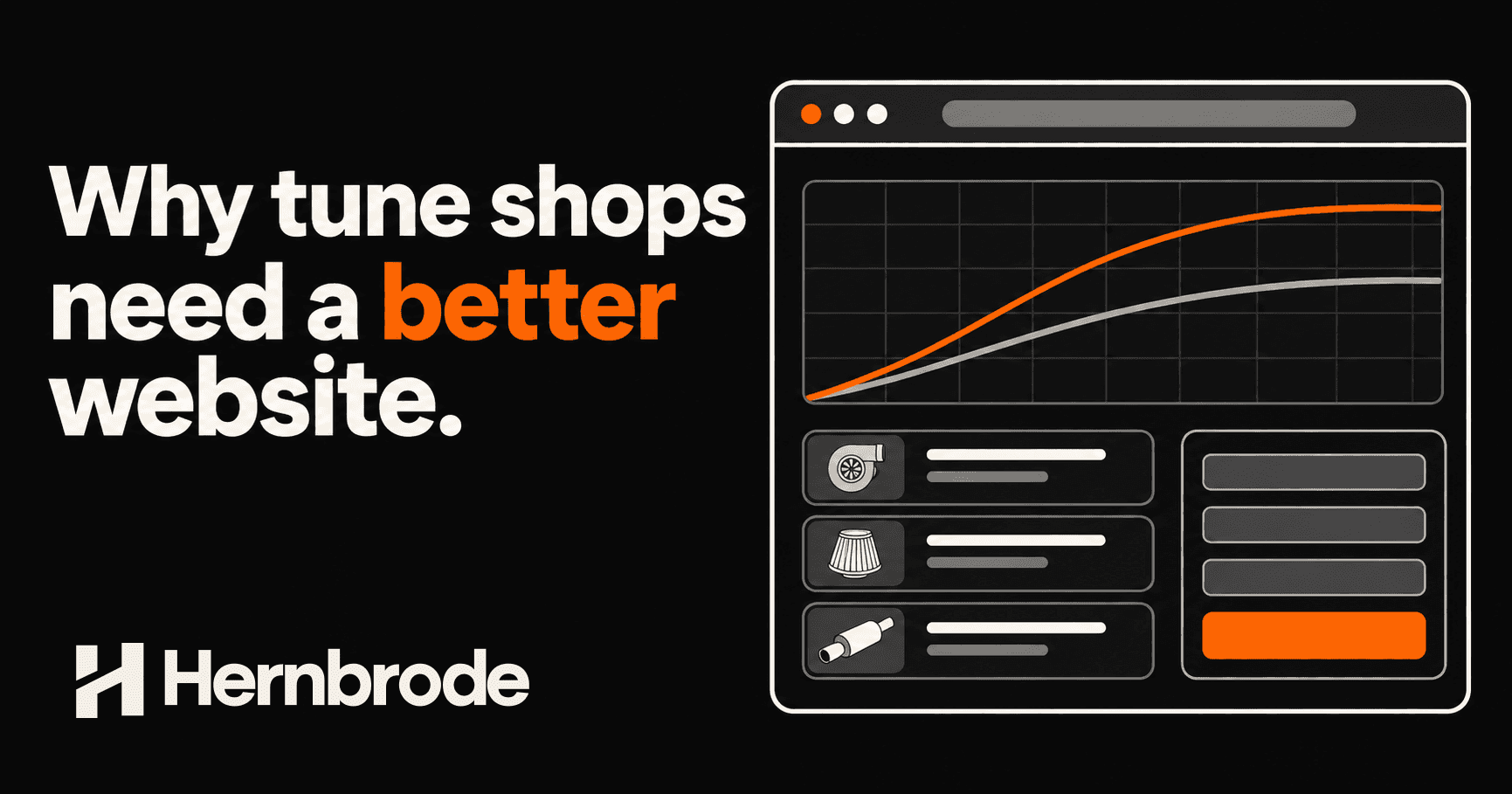
- Real dyno results. Before and after numbers from cars you’ve actually tuned, with the car and mods listed so owners compare like with like. No rounding up. Nobody trusts a shop that does.
- Parts and installs. What you sell or install, and the brands you use.
- Builds. Photos of cars that came through your shop.
- An inquiry form that asks the right questions. The car, what’s on it now, and what they want from it. You get a better first message and skip the “how much for a tune?” back-and-forth.
I have a sample layout for this on my site, and I’ll be upfront about it: it’s a sample. I don’t have a tune shop client yet, so I’m not going to show you invented dyno numbers or a made-up testimonial.
Proof beats polish
The part of this I’d care most about is the dyno results section. A tune shop’s whole pitch is “I make cars better, and I can show you.” A page that does that with real numbers does more than any slogan.
I took the same approach on a different kind of shop. Golden Era Glassworks is a mobile auto glass shop serving the Oklahoma City area. Its first website was a single page made with GoDaddy Airo. It opened on a video, and the one button on it went to Facebook.
I rebuilt it as a thirteen-page website. Six of those pages are services, each with its own page. The phone number is in the header, and there’s a quote form that takes photos. The shop’s own job photos run through the site. Same idea a tune shop would use: show the real work and make the next step obvious.
I can’t promise a tune shop would see the same results, because I haven’t measured that. But the approach carries over. People comparing shops want specifics, and a page built around specifics is easier to trust.
Keep it honest and keep it current
A few things I’d tell any shop owner:
- Date your results. If a dyno sheet is two years old, say so, or replace it.
- Only list what you really do. If you don’t touch diesels, say that. It saves everyone time.
- Check the form. Send yourself a test inquiry and make sure it actually lands in your inbox. A form that says “Thanks!” and sends nothing is worse than no form.
- Look at it on your phone. That’s where most people will see it, probably standing next to the car.
If you want one
My one-page website covers all of the above, and you own the site when it’s done. Send me a few lines about your shop, the platforms you work on and what you want people to do, and I’ll tell you honestly whether one page is enough.
Sources
- Google Search Central: Creating helpful, reliable, people-first content (opens in a new tab)
- Google Search Central: Mobile site and mobile-first indexing best practices (opens in a new tab)
- Google Business Profile Help: Tips to improve your local ranking (opens in a new tab)
- Hernbrode: Golden Era Glassworks project
- Hernbrode: One-page website offer